
Janmashtami 2026: When Devotion Became a Conversation About Compassion

What would be the most beautiful gift for Shri Krishna?
That simple question became the heart of Animal Save India’s Janmashtami 2026 campaign.
Across Hisar, Khandwa, Mumbai, Thane, Ahmedabad, Chandigarh, Hyderabad, Faridabad and Delhi, activists took the question into public spaces and invited people to reflect on a subject rarely examined during festival celebrations: what compassion towards cows, buffaloes and their children should look like in today’s dairy system.
The campaign asked whether devotion can become more compassionate.
And the response, both on the streets and online, showed just how powerful that question could be.
A Campaign Rooted in Devotion
Krishna’s association with cows occupies a deeply loved place in Indian culture. That made sensitivity essential.
Rather than turning the campaign into an argument about what Krishna ate or what people practised centuries ago, Animal Save India kept the focus firmly on the present.
The question was: “What are cows, buffaloes and their children experiencing in the dairy industry today, and what does compassion ask of us now?”
Participants were shown the campaign video and encouraged to think about the lives behind the milk routinely offered, purchased and consumed during everyday life and religious celebrations.
At the centre of those conversations was another deceptively simple idea:
If Shri Krishna loved cows, what could be a more meaningful gift than refusing to participate in their exploitation?
This allowed activists to speak about dairy ethics without turning faith itself into the target.
From All Cities Came One Question
The strength of the campaign was not only geographical participation. It was the way activists interacted with people.
Teams in many cities carried the same fundamental message while adapting the outreach to their local communities.
The campaign microsite describes the public response as overwhelmingly positive and says the outreach helped bring activists closer to their audiences.
Instead of simply displaying placards and moving on, activists were able to create conversations around worship, tradition, compassion and the lives of other sentient beings.
The campaign’s guiding question - “What would be the most beautiful gift for Shri Krishna?” became a natural entry point.
People did not first encounter a lecture.
They encountered a question.
And a question gave them space to think.
Compassion, served on a plate
Some of the most meaningful moments showed that removing animal exploitation from a festival need not make the celebration less joyful, familiar or generous.
In Chandigarh, activists organised a coconut milk kheer langar, offering visitors a familiar festive sweet prepared without dairy.
In Mumbai, vegan rasmalai was distributed as prasad.
Both initiatives were warmly appreciated.
This mattered because ethical change can sometimes feel abstract until people experience the alternative for themselves.
A bowl of kheer or a serving of rasmalai can demonstrate something that a placard alone cannot: the sweetness, hospitality and celebratory spirit of a tradition can remain while the exploitation is left behind.
Plant-based celebration is not the disappearance of Indian culture.
It can be an evolution of compassion within it.
From a Viral KBC Moment to Conversations on the Street
The Janmashtami campaign also unfolded against a much larger public conversation around dairy ethics.
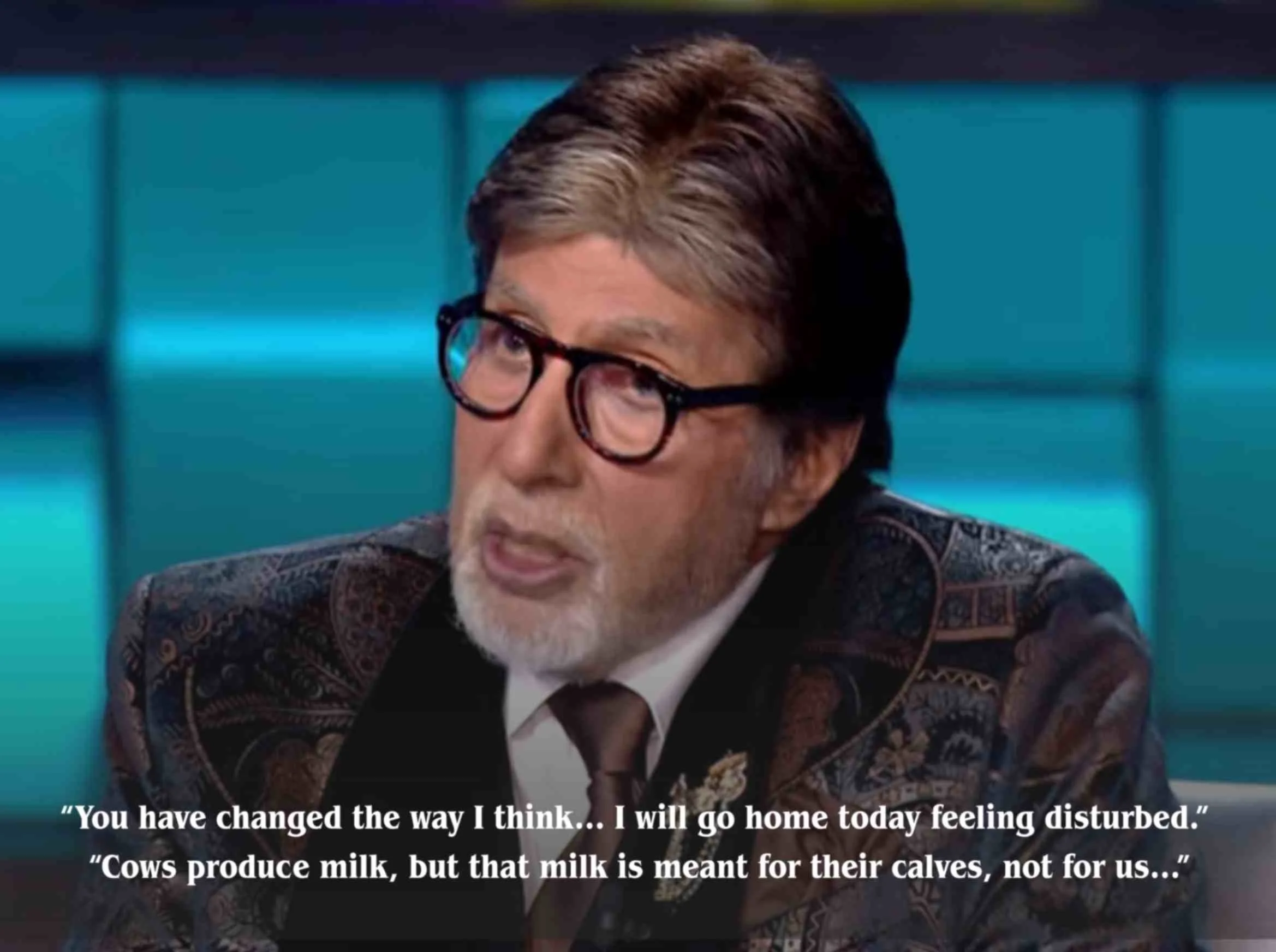
Months earlier, a conversation on Kaun Banega Crorepati between contestant Siddharth Sharma and Amitabh Bachchan had brought veganism and the purpose of a cow’s milk into mainstream Indian discussion.
Sharma explained his ethical objection to taking milk intended for a calf. Bachchan responded with visible reflection, saying that the conversation had changed the way he thought about the issue. The exchange was subsequently covered by national media.
Animal Save India shared the clip on Instagram.
According to Animal Save India’s current Instagram insights, the reel has now crossed 250 crore views.
A question activists have asked for years suddenly entered millions of Indian screens:
Whom is a cow’s milk actually produced for?
The Janmashtami campaign carried that conversation from the digital world into parks, streets and communities.
People could now watch, ask questions, meet activists and experience dairy-free festive food for themselves.
The campaign did not end when the street activities ended.
Together, they show an important part of the campaign’s success: people were not merely viewing the communication. They were responding to it.
That difference matters.
Awareness work is most powerful when people move from seeing to thinking, and from thinking to conversation.
The campaign’s strong digital response reinforced what activists were experiencing on the ground: culturally sensitive animal-rights communication can reach people without abandoning moral clarity.
What Does “Thoughtful Worship” Look Like?
One of the most important outcomes of the campaign was the idea of thoughtful, compassionate worship.
Traditions are powerful because they connect generations. But respecting a tradition does not require refusing to examine how present-day practices affect others.
Animal Save India invited people to look beyond the familiar image of milk as automatically synonymous with love, purity or devotion and instead consider the individuals from whom that milk comes.
A cow is a mother.
A buffalo is a mother.
A calf is someone’s child.
Their lives do not become resources simply because exploitation has been normalised.
For an organisation rooted in animal rights, this is where the campaign ultimately had to lead. The goal is not merely a different ingredient in one Janmashtami sweet. It is to question the assumption that the bodies, reproduction and milk of other animals exist for human use.
A Festival Can Become a Starting Point
Janmashtami lasts for a limited period.
The ethical question raised by the campaign does not.
If compassion towards cows matters during a festival, why should that compassion disappear from our everyday chai, sweets, paneer, curd or other dairy consumption?
That is where reflection has to become action.
For anyone wondering how to make that transition in an Indian household, Animal Save India has created a free Plant-Based Starter Kit with recipes, meal plans, nutrition information and guidance designed around Indian food habits and regional preferences. It is also available in multiple Indian languages.
Explore Animal Save India’s Plant-Based Starter Kit
The Most Beautiful Gift
The success of the Janmashtami campaign cannot be measured only by photographs, city names or social-media reactions.
Its deeper achievement was creating a space where devotion and ethical reflection could exist together.
People watched.
People tasted.
People commented.
People spoke with activists.
Most importantly, people were invited to consider someone who is routinely missing from conversations about dairy: the mother whose milk is taken and the child for whom her milk exists.
If devotion means love, protection and compassion, those values should extend beyond symbolism.
Let ahimsa reach your plate. Stop funding the exploitation of other animals. Become vegan.
And if you are ready to begin, download Animal Save India’s Plant-Based Starter Kit and carry the compassion of Janmashtami into every day of the year.
What was Animal Save India’s Janmashtami 2026 campaign?
It was a multi-city public-awareness campaign encouraging people to reflect on present-day dairy practices through the question, “What would be the most beautiful gift for Shri Krishna?” The focus was compassion towards cows, buffaloes and their children and the ethical case for veganism.
Which cities participated?
The campaign microsite lists Hisar, Khandwa, Mumbai, Thane, Ahmedabad, Chandigarh, Hyderabad, Faridabad and Delhi.
Was Amitabh Bachchan part of the Janmashtami campaign?
No. The campaign references a separate viral KBC conversation involving Amitabh Bachchan and contestant Siddharth Sharma because that interaction helped bring dairy ethics into mainstream public discussion. Bachchan’s response should not be interpreted as an endorsement of Animal Save India or veganism.
Where can I learn how to become vegan in India?
Animal Save India offers a free Plant-Based Starter Kit containing Indian-focused recipes, meal plans, nutrition information and editions in several Indian languages.