The KBC Veganism Moment Was Not Just Viral. It Was a Mirror for India.
A few minutes on national television did what years of polite silence often cannot: it made India pause.
On Kaun Banega Crorepati, contestant Siddharth Sharma spoke to Amitabh Bachchan about veganism, dairy, and the lives of other animals. The moment travelled across social media because it was not framed as a diet trend or a celebrity wellness choice. It was framed as a question of justice.
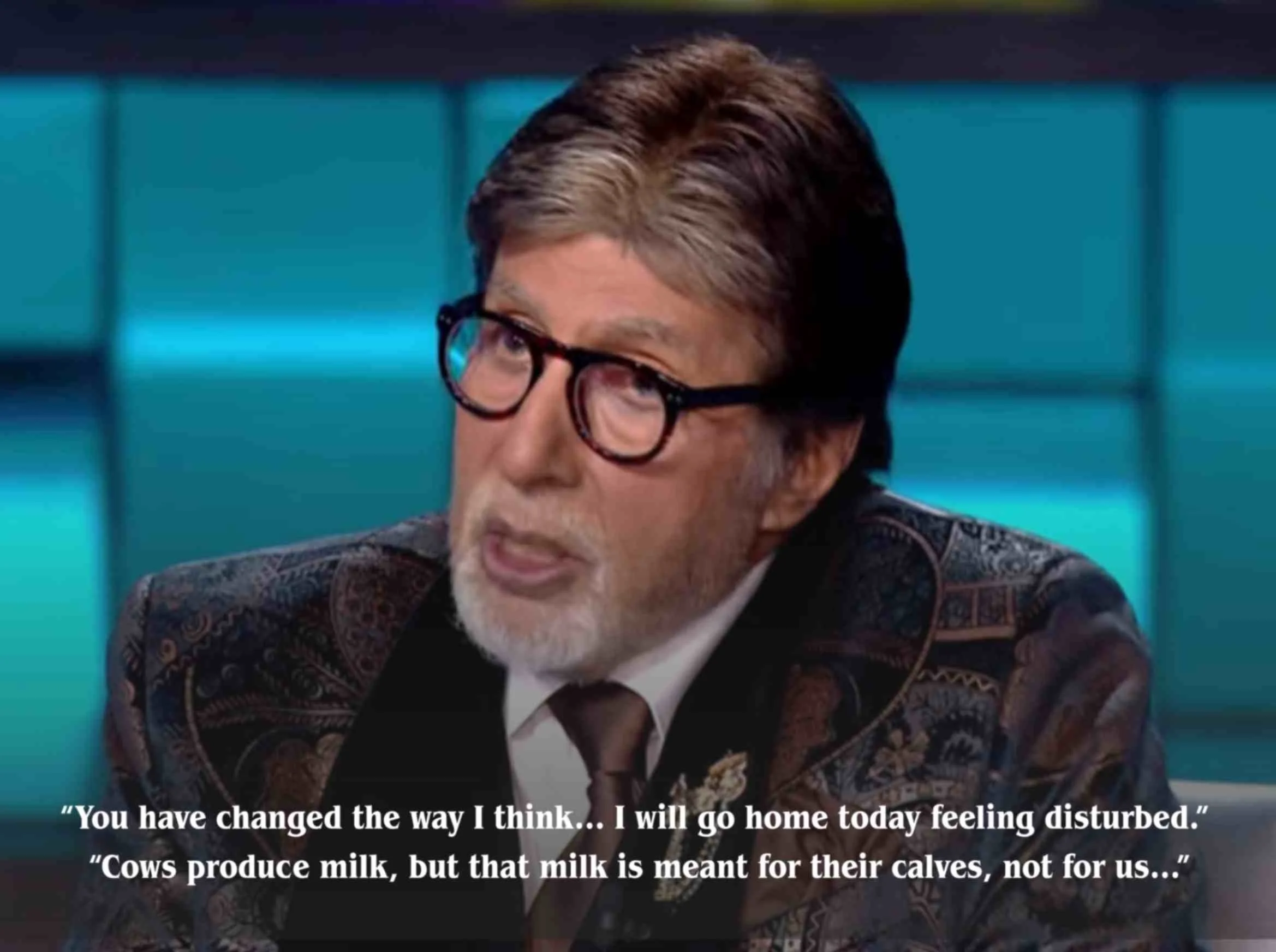
According to The Indian Express, Sharma explained that he does not take anything that comes from other animals and spoke about milk being meant for the calf. The report also noted Bachchan’s visibly affected response, including that the conversation had “opened” his eyes.
That is why this moment matters.
Not because a celebrity reacted. Not because a clip became viral. But because for a brief moment, a mainstream Indian audience heard veganism described as what it truly is: a refusal to participate in the exploitation of other sentient beings.
Veganism Is Not a Diet Trend
One of the biggest misunderstandings about veganism is that it is simply about food.
It is not.
The Vegan Society defines veganism as a philosophy and way of living that seeks to exclude, as far as possible and practicable, all forms of exploitation of and cruelty to other animals for food, clothing or any other purpose.
That distinction matters.
A plant-based diet can describe what is on someone’s plate. Veganism asks a deeper question: should other animals be treated as resources for human convenience?
When veganism is reduced to health, weight loss, fitness, or sustainability alone, the ethical foundation disappears. Those issues matter, but they are not the centre. The centre is this: other animals are not objects. They are individuals with their own lives, bodies, bonds, fears, preferences, and will to live.
Why Dairy Becomes the Hardest Conversation in India
In India, many people already reject animal flesh but continue to see dairy as harmless, sacred, or necessary.
That is why the KBC conversation struck a nerve.
For many Indian families, milk is not seen as exploitation. It is seen as chai, prasad, paneer, ghee, childhood, strength, tradition, and care. But emotional familiarity does not remove the ethical reality.
A cow or buffalo produces milk after pregnancy and birth. The MSD Veterinary Manual notes that milk yield rises rapidly after calving, peaks around 40–60 days after calving, and then declines through lactation.
This basic biological fact changes the entire conversation.
Milk is not a magical liquid that appears for humans. It is tied to reproduction, birth, maternal biology, and the existence of a calf. Dairy normalises taking something that exists because a mother gave birth and turning it into a product for human use.
The ethical question is not whether this has become normal.
The ethical question is whether normalisation makes exploitation right.
India’s Dairy Scale Makes This Conversation Urgent
This is not a small issue in India.
In 2025, India’s Press Information Bureau reported that India ranked first globally in milk production and estimated total milk production at 247.87 million tonnes during 2024–25. The same release reported that per capita milk availability rose to 485 grams per day in 2024–25.
These numbers are often presented as national achievement. From an animal rights perspective, they also point to scale: millions of mothers, calves, buffaloes, cows, and bovines are absorbed into a system that treats their reproductive bodies as production infrastructure.
That is the part India rarely discusses.
We discuss purity.
We discuss protein.
We discuss tradition.
We discuss farmer livelihoods.
We discuss national production.
But we rarely discuss the mother.
We rarely discuss the calf.
We rarely discuss consent.
We rarely discuss the violence hidden behind the word “normal.”
Ahimsa Cannot Stop at Sentiment
India has a powerful moral vocabulary: ahimsa, daya, karuna, seva, dharma.
But if ahimsa is only spoken and not practised, it becomes decoration.
For many people, the KBC moment was uncomfortable because it brought ahimsa into the kitchen. It asked whether compassion should apply only when exploitation is visually obvious, or also when exploitation has been culturally softened.
A calf being separated from their mother is not less painful because society has normalised milk.
A mother being repeatedly used for human demand is not less unjust because the product is familiar.
A buffalo or cow is not less of an individual because the industry has assigned them an economic role.
If we believe other animals deserve freedom from exploitation, then ahimsa cannot end at not eating animal flesh. It must also question milk, curd, paneer, ghee, butter, leather, wool, eggs, honey, entertainment, testing, and every other form of use where other animals are treated as means to human ends.
The KBC Moment Worked Because It Was Simple
The most powerful part of the exchange was not technical. It was not full of complicated terms. It was morally direct.
Other animals want to live.
Milk is for the calf.
Taking from them is not ethical.
That is why people listened.
The conversation did not need shock language. It did not need hatred toward people. It did not need to insult Indian culture. It simply placed a familiar habit next to an uncomfortable truth.
This is the kind of public conversation India needs more often.
Not one that shames individuals into silence, but one that refuses to let society hide behind habit.
What Science and Ethics Are Already Telling Us
Modern science continues to challenge the outdated idea that other animals are biological machines without meaningful inner lives.
The Cambridge Declaration on Consciousness in Non-Human Animals was publicly proclaimed in 2012 at the University of Cambridge, after a conference involving scientists working on consciousness.
Scientific understanding will continue to evolve, but the ethical direction is already clear: where there is sentience, subjectivity, fear, pain, attachment, and a will to live, there is moral responsibility.
Veganism begins there.
It asks us to stop treating other animals as ingredients, materials, tools, entertainment, or commodities. It asks us to recognise that their lives belong to them.
What This Means for Indian Families
This conversation will not always be easy at home.
For many Indian families, dairy is deeply emotional. Chai may feel incomplete without milk. Paneer may feel central to hospitality. Ghee may be treated as sacred. Older relatives may see veganism as rejection of culture.
But becoming vegan is not a rejection of Indian food.
Dal, rice, roti, sabzi, idli, dosa, poha, upma, chole, rajma, khichdi, coconut chutney, peanut chutney, sesame, millets, pulses, soy, and countless regional dishes already show how plant-rich Indian food can be. What needs to change is not India’s food identity, but the assumption that compassion can coexist with exploitation.
We do not need to abandon Indian culture to become vegan.
We need to expand the best of Indian ethics — especially ahimsa — to include the beings whose bodies have been excluded from our compassion.
Common Myths After the KBC Veganism Moment
Myth 1: “Cows naturally need humans to milk them.”
Reality: Cows and buffaloes produce milk after pregnancy and birth. Dairy creates the lactation cycle and then presents extraction as care. Milk is tied to motherhood, not human entitlement.
Myth 2: “Dairy is different from animal flesh.”
Reality: The products look different, but both depend on treating other animals’ bodies as resources. Ethical veganism challenges the use itself, not only the final form on the plate.
Myth 3: “Veganism is Western.”
Reality: The word may be modern, but the ethical foundation is deeply compatible with ahimsa, compassion, non-violence, and moral restraint. Indian kitchens already contain many plant-based foods.
Myth 4: “If something is traditional, it cannot be questioned.”
Reality: Every society has traditions that deserve preservation and traditions that deserve moral review. Compassion grows when we are willing to question what we inherited.
Myth 5: “This is only about celebrities.”
Reality: The celebrity moment created attention, but the issue is much larger. The real question is whether ordinary people are willing to align everyday choices with compassion.
The Real Question the KBC Moment Leaves Us With
The KBC moment did not force anyone.
It simply made denial harder.
Once we understand that dairy is connected to pregnancy, birth, separation, and exploitation, we cannot honestly call it harmless. Once we understand that veganism is about justice for other animals, we cannot reduce it to a diet trend. Once we understand that ahimsa must include those who are unheard, we cannot keep compassion limited to words.
India does not need another soft conversation about “kindness” that changes nothing.
India needs moral clarity.
If we believe other animals are not objects, then our food, clothing, festivals, institutions, and family habits must reflect that belief.
The next step is not to admire the KBC moment and move on. The next step is to become vegan.
Let ahimsa reach your plate, your wardrobe, your home, and your daily choices. Stop funding animal exploitation. Become vegan.
Explore Animal Save India’s vegan resources, share this article with someone who still sees dairy as harmless, and bring this conversation into your family, school, college, workplace, or community.
FAQs
What happened in the KBC veganism moment?
Contestant Siddharth Sharma spoke to Amitabh Bachchan on Kaun Banega Crorepati about veganism and why he avoids taking anything that comes from other animals. Media reports noted that Bachchan appeared affected by the explanation.
What is veganism?
Veganism is a philosophy and way of living that seeks to exclude, as far as possible and practicable, exploitation of and cruelty to other animals for food, clothing, or any other purpose.
Why do vegans avoid dairy?
Vegans avoid dairy because milk is tied to pregnancy, birth, lactation, and the use of mothers and calves in a system designed for human consumption. The ethical issue is not only cruelty in individual cases; it is the exploitation itself.
Is veganism against Indian culture?
No. Veganism challenges exploitation, not Indian culture. Indian food already includes many plant-rich meals such as dal, rice, roti, sabzi, idli, dosa, poha, chole, rajma, khichdi, and millet-based foods. Veganism asks India to expand ahimsa to other animals.
What should I do after watching the KBC veganism clip?
Do not stop at appreciation. Learn what dairy, eggs, animal flesh, leather, wool, and other products of exploitation involve. Then make your ethics practical: become vegan.