Mahatma Gandhi on Animals and Veganism: What Gandhi and Other Great Thinkers Actually Believed
Gandhi was a committed vegetarian who repeatedly examined whether consuming milk was compatible with ahimsa. He stopped drinking milk for years, wrote about cruelty toward cows and buffaloes, experimented with alternatives, later returned to goat's milk during serious illness, and openly admitted that doing so conflicted with the spirit of a vow he had made.
His writings reveal something far more valuable than a convenient historical label: a person repeatedly questioning whether compassion was consistent with using another sentient being's body for human purposes.
And Gandhi was not alone.
Across centuries, figures as different as Leo Tolstoy, Emperor Ashoka, Albert Schweitzer and, eventually, vegan pioneer Donald Watson challenged the idea that moral responsibility should stop at the boundary of our own species.
Their conclusions were not identical. They should not all be called vegans.
But together, their words raise a question that remains profoundly relevant today:
If we believe in nonviolence, compassion and justice, how far should those principles extend?

Before We Begin: Gandhi Was Not Vegan
Historical accuracy matters.
The term vegan was coined in 1944 when Donald Watson and other non-dairy vegetarians founded The Vegan Society. The organisation later defined veganism around avoiding, as far as possible and practicable, human exploitation of other animals, rather than merely following a particular diet.
Gandhi died in 1948, but there is no reliable evidence that he adopted a vegan identity.
Calling him vegan would therefore oversimplify his life.
What we can say, because Gandhi said it himself, is much more interesting.
He seriously questioned milk.
Mahatma Gandhi: When Ahimsa Reached the Question of Milk
Gandhi's relationship with dairy was complicated.
In his autobiography, Gandhi described learning about the suffering inflicted on cows and buffaloes in the dairy practices of his time. He wrote that this knowledge had a powerful effect on him and contributed to his decision to abandon milk.
For approximately six years, according to his writings on vegetarianism, Gandhi excluded milk from his diet.
Then came a serious illness.
After suffering severe dysentery and struggling to regain strength, Gandhi was persuaded to drink goat's milk. His original vow had particularly concerned cow's and buffalo's milk. But Gandhi himself rejected the convenient distinction.
He acknowledged that by drinking goat's milk he had kept the technical wording of his promise while violating its spirit.
That admission deserves attention.
Gandhi did not simply rewrite his ethical position to make his behaviour more comfortable. He recorded the contradiction.
Gandhi Went Further Than Simply Opposing Cruelty
In a 1926 letter preserved in the Collected Works of Mahatma Gandhi, Gandhi wrote critically about milk itself and acknowledged that he continued drinking goat's milk despite his ethical unease.
Elsewhere, discussing vegetarianism, he wrote:
“We are certainly not entitled to any other milk except the mother's milk in our infancy.”
That statement represents Gandhi's own historical view, not modern nutritional guidance. But ethically, it is striking.
The question was no longer simply: Are cows treated kindly?
It was moving toward a deeper question:
Are humans entitled to their milk in the first place?
That distinction is central to modern ethical veganism.
Gandhi's Idea of Cow Protection Was Also About Human Conduct
Gandhi frequently wrote about protecting cows, but he rejected the idea that concern for cows justified violence against humans.
He argued instead for persuasion, personal conduct, education and kindness. He also criticised how cows, calves and working bovines were treated within Indian society itself.
This makes his position relevant to India today.
It is easy to declare reverence for a cow symbolically.
It is harder to ask what reverence requires when her body is economically useful to us.
Does respect continue when her milk is wanted?
What happens to her calf?
What happens when her productivity declines?
Can a relationship genuinely be called compassionate while another sentient individual is valued according to what humans can obtain from her body?
Gandhi did not develop the contemporary animal-rights framework used today. But his insistence on self-examination gives us the moral vocabulary to ask these questions.
Ahimsa cannot be measured only by what we claim to love.
It must also be examined through what we participate in.
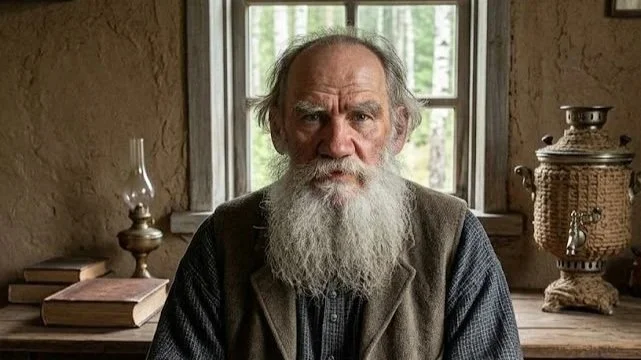
Leo Tolstoy: You Cannot Separate the Meal From the Killing
Gandhi and Russian writer Leo Tolstoy influenced one another intellectually, especially around nonviolence.
Tolstoy also became one of the most forceful early critics of killing other animals for food.
In his essay The First Step, he described visiting a slaughterhouse in Tula because he wanted to confront directly what eating animal flesh required.
Tolstoy's conclusion was uncompromising. He argued that using animal flesh involved an act contrary to moral feeling: killing.
The significance of Tolstoy's argument was not simply dietary.
He was challenging moral distance.
A person could enjoy the finished meal while somebody else performed the violence required to produce it.
By walking into the slaughterhouse, Tolstoy removed that distance.
More than a century later, that remains one of the most important questions in animal ethics:
Would our choices change if the process behind them were no longer hidden from us?
Oxford scholarship on Tolstoy's animal ethics notes precisely this dimension of his work: he wanted readers not merely to know intellectually what slaughter involved, but to perceive its moral reality.
Tolstoy was a vegetarian, not a documented vegan in the modern sense.
But his argument that nonviolence should reach our food choices helped push ethical concern beyond abstract sympathy.
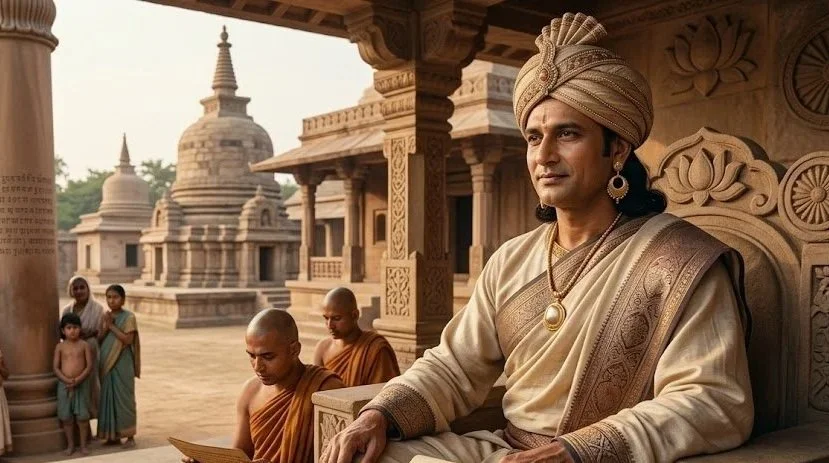
Emperor Ashoka: When Compassion Became Public Policy
More than two thousand years before the modern vegan movement, Emperor Ashoka attempted to place restraint toward other living beings within governance.
The Girnar edicts, documented by India's National Museum, include restrictions on killing living beings for sacrifice, instructions encouraging abstention from killing, and provisions for medical treatment for both humans and other animals.
Archaeological Survey of India material on Ashokan inscriptions similarly records compassion toward other animals as part of the dhamma he sought to promote.
Ashoka was not vegan, and his policies should not be rewritten as modern animal-rights politics.
Their significance lies elsewhere.
They demonstrate that extending moral consideration beyond humans is not a foreign idea recently imported into India.
Questions about nonviolence toward other beings have existed within the subcontinent's ethical traditions for millennia.
The modern question is whether we are prepared to follow those principles consistently when exploitation has become industrial, normalised and economically convenient.
Albert Schweitzer: “Reverence for Life”
Physician, philosopher and Nobel Peace Prize laureate Albert Schweitzer developed an ethical principle he called Reverence for Life.
His starting point was simple: human life exists among other lives that also strive to continue living.
The institution preserving Schweitzer's legacy explains that his philosophy demanded more than avoiding harm. It called for active concern for the beings around us, including other animals.
In correspondence, Schweitzer expressed the idea succinctly:
“Every life is sacred.”
Schweitzer was not presenting modern vegan philosophy, and we should not pretend otherwise.
But he challenged a hierarchy that still shapes human thinking: the assumption that ethical worth begins with humans and becomes optional outside our species.
Modern animal rights takes that challenge further.
If another sentient being's life matters to them, then the question is not merely whether we can treat them somewhat more kindly.
The deeper question is whether we have the right to turn their body, reproductive system, labour or life into a resource at all.
Donald Watson: From Compassion to Veganism
This is where Donald Watson represents an important historical shift.
Watson became vegetarian as a teenager. Eventually he concluded that refusing animal flesh while continuing to use dairy and other animal-derived substances did not resolve the underlying ethical problem.
In November 1944, Watson and a small group of other non-dairy vegetarians established The Vegan Society and adopted the word vegan.
A few years later, Vegan Society member Leslie Cross described the principle behind veganism as the emancipation of other animals from human exploitation. That principle evolved into the Society's contemporary definition of veganism.
This was an important philosophical development.
Vegetarianism asks us not to eat animal flesh.
Veganism asks something broader:
Why should another sentient individual's body belong to us at all?
That question reaches dairy.
It reaches eggs.
It reaches leather, wool, experimentation, entertainment and other systems in which nonhuman animals are treated as resources.
And interestingly, it brings us back to the conflict Gandhi himself was wrestling with decades earlier when he questioned whether humans were entitled to another species' milk.
What Connects Gandhi, Tolstoy, Ashoka, Schweitzer and Watson?
Their philosophies are not interchangeable.
Ashoka governed an ancient empire.
Tolstoy approached the question through Christianity, morality and nonviolence.
Schweitzer formulated Reverence for Life.
Gandhi approached his choices through satya, ahimsa, restraint and personal experimentation.
Watson helped articulate modern veganism.
But one ethical movement can be seen across these very different histories:
the expansion of the moral circle beyond ourselves.
From avoiding unnecessary killing.
To recognising suffering.
To questioning our entitlement.
To challenging exploitation itself.
That last step matters.
Because kindness alone can coexist with ownership and exploitation.
Someone may feel affection toward a cow and still believe humans are entitled to her milk.
Someone may dislike slaughter while continuing to fund industries in which other sentient beings ultimately become commodities.
Veganism asks us to move beyond being kind masters.
It challenges the assumption that humans should be masters at all.
Ahimsa in Modern India Cannot Remain Symbolic
India speaks constantly about ahimsa, daya, karuna and dharma.
These are powerful ethical traditions.
Yet dairy remains so deeply embedded in everyday life that its use is rarely subjected to the same moral scrutiny as killing.
Milk appears as chai.
Curd appears with meals.
Ghee appears in rituals.
Paneer appears at celebrations.
Because these practices are familiar, they can feel morally neutral.
But familiarity is not an ethical argument.
Gandhi's writings are particularly relevant here precisely because even he struggled with this contradiction.
Instead of using Gandhi as a historical stamp of approval for whatever we already do, perhaps the more Gandhian response is to continue the experiment.
Ask the uncomfortable question.
Examine our behaviour.
Follow truth even when truth interferes with convenience.
Animal Save India itself draws upon the Gandhian principles of Satya and Ahimsa in its nonviolent approach to social change.
Today, we know that living vegan means extending that ethical examination beyond animal flesh to dairy, eggs, clothing, entertainment and other forms of animal use.
Gandhi Does Not Need to Have Been Vegan for His Questions to Matter
There is a temptation in every movement to claim admired historical figures as members of the cause.
We do not need to do that.
Gandhi was not vegan.
Ashoka was not vegan.
Tolstoy should not be retroactively presented as vegan.
Schweitzer's Reverence for Life was broader and different from contemporary veganism.
Their value lies not in giving veganism famous endorsements.
Their value lies in demonstrating how repeatedly, across cultures and centuries, humans have reached the same uncomfortable boundary:
Our moral principles become meaningful when they apply to those over whom we have power.
Modern veganism carries that reasoning to its logical question.
If other animals are sentient individuals rather than commodities, why should their bodies, milk, eggs, skin, labour or lives belong to us?
Gandhi spent his life describing his pursuit of truth as an experiment.
Perhaps one of the most meaningful ways to honour that legacy is not merely to quote ahimsa.
It is to keep expanding its practice.
Let ahimsa reach your plate, your clothing and your everyday choices. Stop funding the exploitation of other animals. Become vegan.
If you are wondering where to begin in an Indian household, Animal Save India has created a free Plant-Based Starter Kit containing recipes, meal plans, nutrition information and guidance designed around Indian food habits, with editions available in several Indian languages.